
(Photo Courtesy: Isabel Grau)
Amazonian shamanism, Ayahuasca, plant medicines – Q&A for Life Art Media

(Photo Courtesy: Isabel Grau)
Amazonian shamanism, Ayahuasca, plant medicines – Q&A for Life Art Media
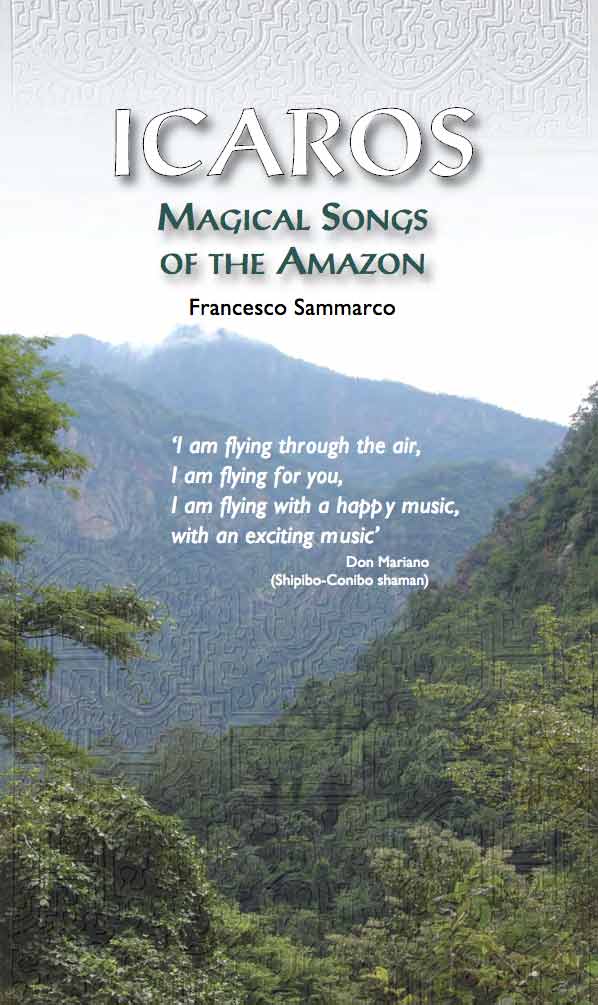
“Icaros: magical songs of the Amazon”. Article originally published on “Sacred Hoop” magazine.
“Icaros: Magical Songs of the Amazon” by Francesco Sammarco. Ayahuasca sacred medicine songs and shamanic melodies for healing and protection from the shamans of the Peruvian Amazon. FREE download of the PDF article originally published on “Sacred Hoop” magazine (www.sacredhoop.org)!

An extremely rare giant specimen of black ayahuasca (Suni/Solimán ayahuasca, or ayahuasca negra), one of the most powerful varieties known, believed to be over 400 years old, growing wild in the jungle of our retreat centre, near Iquitos (Peruvian Amazon rainforest).
“Happy is he among men upon earth who has seen these mysteries…”
Homeric Hymn to Demeter
There are many local designations for the visionary and healing brew that goes under the common name of Ayahuasca. Yajé, Yagé, Remedio, or Purihuasca (in Colombia), Caapi, Hoasca or Daime (among Brazilian religious adepts), among the Shipibos it’s Oni, among the “Amawaka” (Yora) Indians it’s Oni xuma, the Ashaninka natives call it Kamarampi, whilst the Jibaros call it Natema. Its most widespread nickname in Peru it’s medicina (medicine), or la purga (the purge).
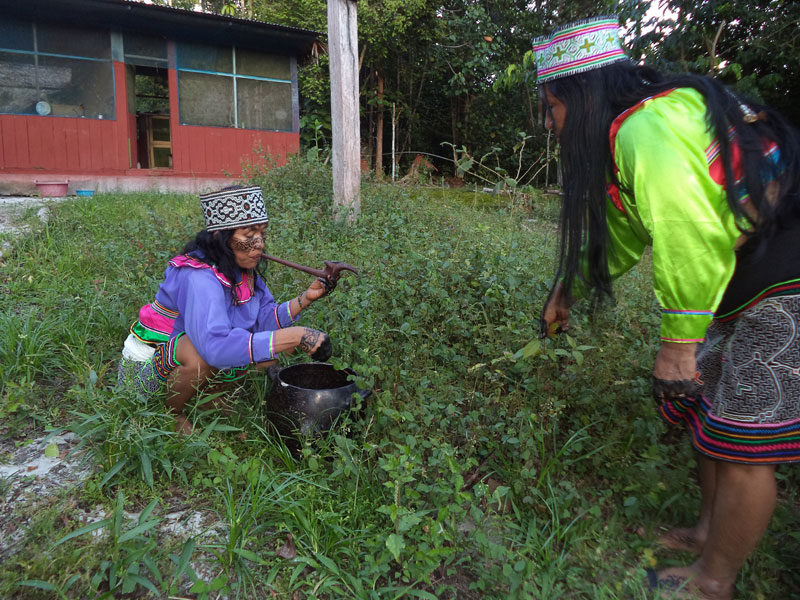
Gathering the Sigueme-sigueme plant teacher. Photo © M. Mori
We support and fully embrace the traditional “shamanistic” view on Ayahuasca and plant spirit medicine, over and above the ”psychonautic” perspective which lacks (in our humble view) the discipline, solidity and depth that a proper, traditional shamanic training and initiation in the jungle – with respected elder shamans as guides – would be able to offer one. The degree of depth of this experience will always be intrinsically dependent on your own tuning with the shamans’ and the plant teachers’ world, with intent, humbleness, respect and dedication.
Neither the Ayahuasca nor the Shamanic Plant Diet retreats have anything to do with a psychedelic adventure, and less so with an escape from the “reality” of our worldly affairs. To the contrary, these experiences are meant to consciously transform and enlighten people, for them to discover their inner nature, their position in the planet, to shed off what is not anymore necessary in their lives. We take Ayahuasca with the spirit of trappers in search of our lost self. Paradoxically, to invert the proportions of what we may perceive as real today, there are some Amerindian tribes who repute the world to be truly real only when one drinks Ayahuasca. We tune-in very much with this vision. As much as we value your personal evolution, development and healing over and above the mere sensorial experience of “hallucinations”, and to a certain extent, even over and above the “visions” you may receive.
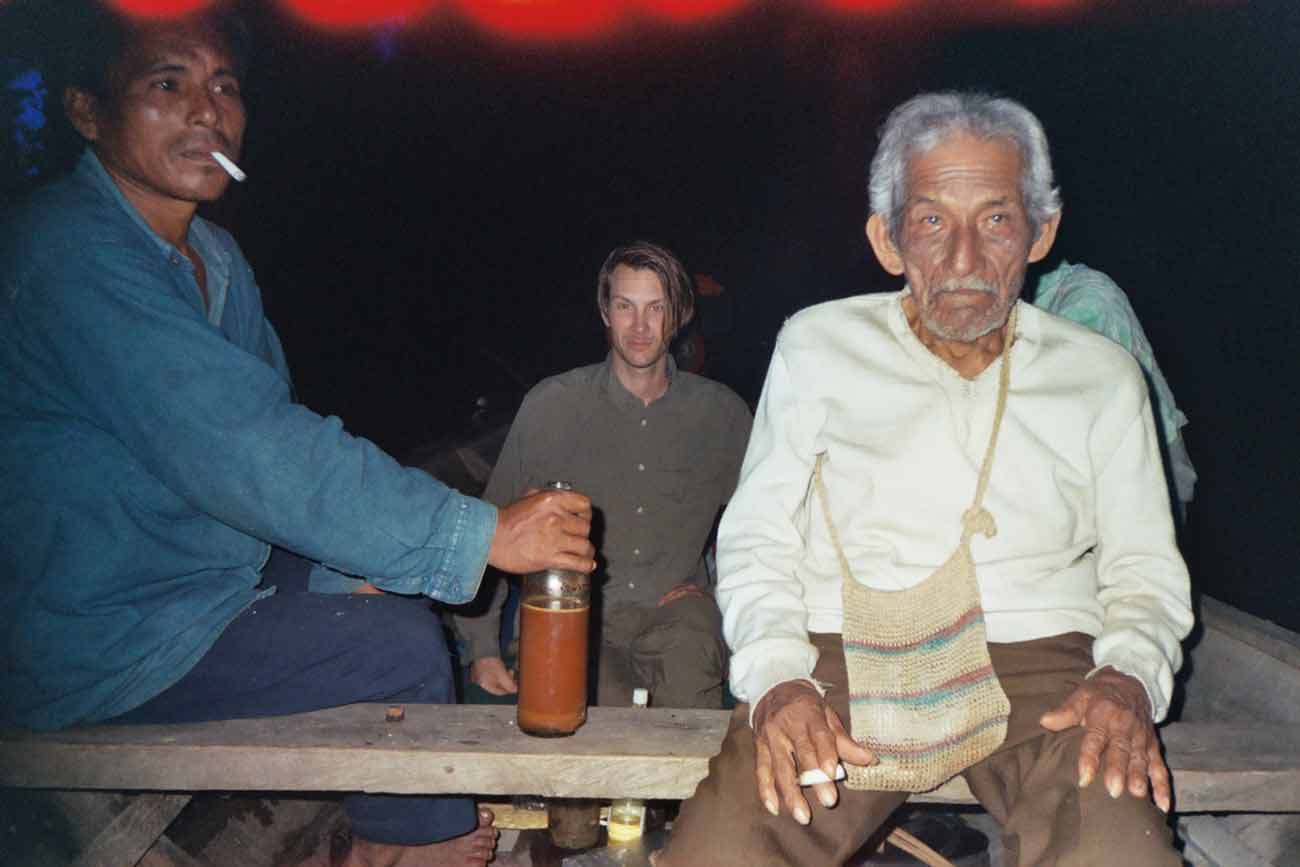
El Mundo Magico shamanic expedition. Ayahuasca ceremony at night on a 10 metres long boat (!) on the Cocha Supay, the “lagoon of the underworld”, in a remote area of the Peruvian Amazon, with Maestro Palero Don Julio Llerena Pinedo (right). Photo: R. del Castillo © El Mundo Magico
by Francesco Sammarco & Dino Palazzolo
Don Julio Llerena Pinedo was a remarkable “Maestro Palero” (an Amazonian shaman specialized in working with ”palos maestros”, or master trees), and an ”espiritista’ (follower of the ”spiritualist” esoteric tradition), with over 41 years experience in working as a ”vegetalista” (a term which distinguish the non-tribal shamanic healers of the Amazon region of Peru). What follows here is the account of his first ”dieta” (e.g. the traditional shamanic training) with ”plantas maestras” (teacher plants) – and how he entered this magical world – as it was narrated to Dino Palazzolo and Francesco Sammarco, respectively, in May 2001 and in September 2002. Don Julio worked with El Mundo Magico as part of our remote shamanic expeditions in the Amazon rainforest of Peru, until 2003/2004.
He lived with his family, treated his patients and took care of his ”chacra” (small allotment of land, in a cleared jungle plot, cultivated with manioc and plantains) in the Northern Peruvian Amazon, some 300 km downriver from the jungle town of Iquitos. Sadly, Don Julio – after a long period of retirement – passed away in Iquitos, at the age of 89, on the 19th of January 2007.
A very moving and gentle healing icaro of Don Julio – recorded live by us during a memorable Ayahuasca ceremony with him in 2002 – is featured in our special icaros compilation available for download at the page here.

Among the many scholars who have investigated the ancient and contemporary use of the psychoactive San Pedro (Huachuma) cactus in Peru, we would like to remember, in particular, Italian Archaeologist and Anthropologist Mario Polia. His impeccable ethnohistorical investigation of the ancient sources and records – many of which translated/published for the first time over many centuries – cross-referenced with important archaeological data, presented a corpus of precious documentation essential in understanding the practice of contemporary curanderos, as well as the ritual, mythical and religious context where the traditional healing practices that had at their core the ceremonial use of the San Pedro cactus originated.
The most ancient records that we have to date as testimonial of the use of a cactus belonging to the genre Trichocereus in ancient Peru, go back to 1643-897 B.C., in the archaeological complex of Garagay, Lima, where spikes of the aguacolla cactus where found mixed in the clay of adobe bricks (Polia, 1999: 137); two spikes represented what were possibly the staffs of a small idol whose eyes were formed by the shells of the mullu conch (Burger, 1992:64, in Polia, Ibidem).
In the circular, sunken plaza of the ancient temple at the oracular complex of Chavin de Huántar, traditionally dated from 1300 B.C. (or from 850 B.C., as other researchers tend to say) an anthropomorphic being, with harp-eagle claws, feline fangs, and wings, is portrayed in a low-relief slab, in the act of holding with his left hand a columnar cactus generally identified as San Pedro.
Achuma, Santiago-Illap’a and the power of lightening. Two unpublished documents from the Archivio Romano de la Compañia de Jesús (Roman Archive of The Jesus Society – or “ARSI”) contains reference to the use of achuma – a word of dubious origins with which in Colonial times people referred to the San Pedro cactus. Of these documents, both referring to the use of the plant in the province of Potosi’, in modern Bolivia, one in particular mentions the existence of a syncretistic cult that included the communal ingestion of the achuma juice rotating around the central figure of the Achumeros, the ministers of the cult. In this cult, the administration of the Eucharist was substituted by slices of the San Pedro cactus, within which it was believed that the power of lightning – addressed with the syncretistic name of Santiago – secretly dwelled. This figure derived from a syncretistic assimilation of the image of the apostle Santiago with Illap’a, the ancient indigenous Andean divinity of lightning (Polia 1999, 138). The power of Santiago manifested itself with the appearance/look/features of the homonymous apostle whose arrival was announced by the shaking of – and tremors in – the ceremonial area. The theophany of the achuma spirit in the devotee – in a similar way – was perceived as a fulguration of the conscience of the ceremony participant, a lightning force that pierced his consciousness like a thunderbolt. Before ingesting the juice of the achuma, and experiencing their ecstatic communion with the divine plant, devotees danced around the sacred area, where slices of the sacred plant were put. The Christian commenter who reported the event at the time (in 1637-1638), did not spare his judgemental views on the topic of the ingestion of the achuma juice, which he perceived tout court as an invention of the Devil, after which cult participants would “loose their mind”.
According to the type of vision one had after drinking the sacred beverage, the response of the Santiago deity to a participant’s query – given through the intermediation of the Achumero – could have been either auspicious, or unfavourable. The vision of a garden, or of a forest, would represent a happy omen, whilst the vision of dead people, an in-auspicious one. The mythical, timeless and space-less dimension of the visionary “garden” is matched by the vision of gardens in today’s Andean curanderos. The plants of these visionary gardens blossom all together, in the same place, regardless of the specific growing season peculiar to each botanical specimen.
Burger, R.L. “The Sacred Center of Chavín de Huántar”, in: The Ancient Americas: Art from Sacred Landscapes. R.F. Townsend, ed., pp. 265-78, Chicago 1992
Polia Meconi, Mario: La Cosmovisión Religiosa Andina en los Documentos Inéditos del Archivio Romano de la Compañia de Jesús (1581-1752), Pontificia Universidad Católica del Perú, Fondo Editorial, Lima 1999
Polia Meconi, Mario: Despierta, remedio, cuenta: adivinos y médicos del Ande, Pontificia Universidad Católica del Perú. PUCP, Lima 1996

San Pedro (Huachuma) ceremony in our centre, in the Peruvian Amazon jungle, near Iquitos.
“And after these things I saw four messengers, standing upon the four corners of the land, holding the four winds of the land, that the wind may not blow upon the land, nor upon the sea, nor upon any tree.” Revelation, 6:1
Trichocereus Pachanoi B.R. is the botanical name of the night blooming and mescaline-bearing columnar cactus once known as “Achuma” and currently known in the Andean and coastal communities of Peru as “San Pedro”, “Wachuma”, “Huachuma”, or “Gigantón”. Botanists N. L. Britton and N. J. Rose were the first to classify the plant in 1920. It is found in Andean Ecuador, Peru and Bolivia; in Peru, it also grows in many places along the northern coast.

San Pedro (Huachuma) brew. Photo: F. Sammarco © El Mundo Magico
Local curanderos maintain that there are seven different species of San Pedro, all distinguished by the number of longitudinal ribs. The one they most commonly use is a seven-ribbed cactus. The rarest and most revered one, has four ribs. This is the sacred cactus of the Four Winds, the San Pedro of the cuatro vientos. Those who find it are thought to be very lucky (Sharon, 1978:39), great shamans or about to become such (Polia 1997:19). This cactus is also reputed to have special healing powers, in lieu of the magical link with the number four – and its correspondence with the “Four Winds” and the “Four Roads” – the supernatural powers associated to the cardinal directions, invoked during the San Pedro healing ceremonies (Sharon, 1978:39).

Photo: Francesco Sammarco
“Bird priest” (lower figure on the right, with wings, beak-like nose and foots to shape of a bird’s claws) in front of the Lord (taller figure on the left), on the motif of the presentation of the sacrificial blood of defeated and captive warriors, offered in a goblet. An Ulluchu fruit is at the feet of the Lord.
The topics linked with the ritual use of the “Ulluchu” fruit among the Moche people of ancient Peru mostly speak of ritual combat, war, sacrificial practices, ritual blood-letting and – possibly – as we shall see, even of the shamanic, otherworldly, ecstatic visionary journeys of their warrior-priests.
The elusive Ulluchu has been previously associated to Carica candicans – a kind of wild papaya (Carica papaya L.) with anti-coagulant properties – by Italian archaeologist and anthropologist Mario Polia, and most recently convincingly identified by Rainer W. Bussman and Douglas Sharon as a group of species of the genus Guarea, belonging to the Meliacea family.
One of the first depictions of this rare fruit appears in the Moche culture [circa 1-750 CE] of Peru, in a banner associated to what has been called the “Ulluchu Man”, a figurine about 50 cm tall representing an odd-looking half-crab half-anthropomorphic deity, found in level 1 of the burial site of the “Lord of Sipán”. The Lord was a high-ranking shaman, or a priest, a warrior-priest, a spiritual leader, or a bit of this all, found in an impressive Moche burial ground, near Chiclayo, in Peru.
Located 31 km from the Peruvian capital, on the old Southern Pan American Highway, overlooking the fertile Lurin Valley and the Pacific Ocean, this vast ceremonial complex housed the important oracle of Pachacámac – “The One Who Generates the World” – great god of creation, of the spirit that permeates every living thing, a fearsome deity associated with war and whose anger resulted in tremors and earthquakes.

The terraced adobe mud-brick Pyramid in Pachacamac, with central access ramp. Ichimay Culture

The Inca “House of the Sun Virgins”, or Acllawasi

The wooden Idol of the Pachacamac God: ”The One Who Generates the World” (detail)
Photo Credit: Francesco Sammarco
Built centuries before the coming of the Incas, possibly occupied from as early as 200 AD and already fully active by 500 AD, the ritual complex was inhabited by several pre-Columbian cultures which built along the centuries an impressive network of palaces, plazas, and pyramidal temples. All encompassed by richly frescoed precinct walls of adobe mud bricks which granted accesses to the plazas by means of the many doorways going though them.
The site is reputed to have been the most important pre-Hispanic religious centre of Peru, along with Cusco, and certainly the most important Sanctuary along the coast. At the time of the warrior-like powerful Huari empire (born around 600 AD) – that spread over and controlled half of modern Peru – Pachacámac was already a major point of pilgrimage.
Through the centuries, the pattern of intense pilgrimages extended far beyond the geographical boundaries of the Lurin Valley, attracting scores of devotees from the central Andes that came here to consult the shrine’s revered oracle. Miguel de Estete (1533) reports in his chronicles that Pachacámac was the destination of pilgrims coming from places as far away as Tacamez, in the Ecuadorian coast, who carried gold, silver and clothes offerings.

Francesco Sammarco with a Q’eros Pampamesayoq, Basilio, in the native community of Kikko (Peru).
Photo: Igni Posadino
Anthropologist Alberto Villoldo reports the comments of his informant (and mentor), Prof. Antonio Morales, regarding the great civilizations who had developed North of the equator, as been characterized by a “descending God”, where “the divine comes from the heavens and descends to the Earth” (Villoldo 1995:172). The Greeks were amid those ancient civilizations who had this marked “descending” character attributed to their divinity. The Incas – unique great culture developing South of the Equator – conversely, had an “ascending” god-force, raising, like the golden maize stalks in the garden of the Koricancha Temple, from mother earth to heaven. Still, we believe there are oversimplifications in this pattern of reconstruction, which do not take into account the many, complex overly-articulated aspects of ancient Greek perception of the divinity, the different phases and stages where these religious ideas were manifested and expressed in -sometimes – conflictual forms, which make any “descending” statement tout-court a bit of an issue in terms of reflecting the actual way these different visions of the world were perceived and channelled in cultic and ritual practices by our Greek ancestors.